For some LGBTQ+ young people in Tanzania, discrimination begins at school, continues at home, and can eventually reach the police station. Their experiences are different, but the consequences are often the same: interrupted education, homelessness, trauma, insecurity and a future placed at risk.
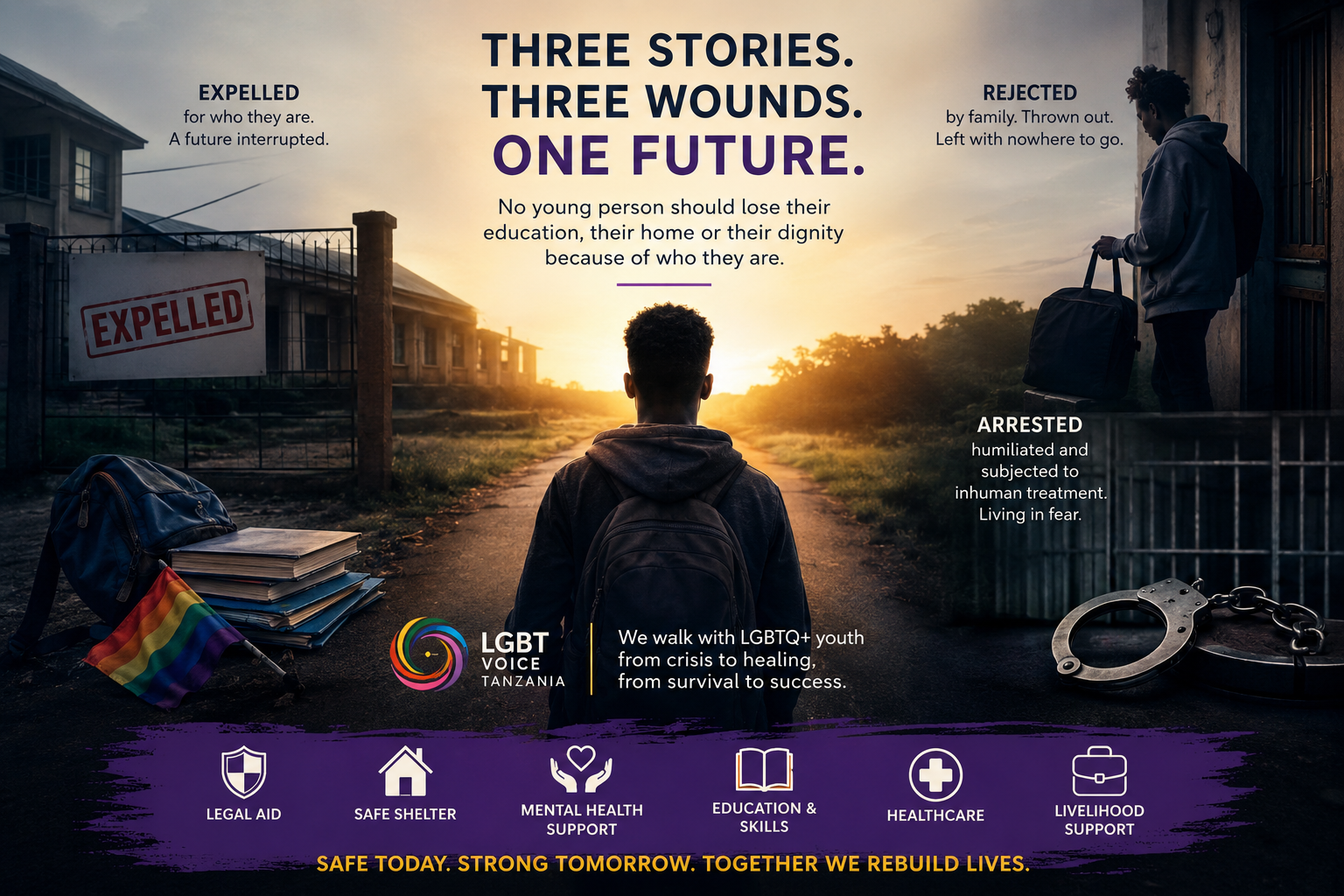
There is a moment when a young person’s future can change in a matter of hours.
A student is told they cannot return to school because they are accused of being homosexual.
A young person arrives home to discover that their family no longer accepts them and orders them to leave.
Another young person is arrested, detained and subjected—or threatened with being subjected—to degrading treatment, including forced anal examination.
These are not three isolated stories.
They represent patterns that LGBTQ+ young people in Tanzania continue to experience.
For their protection, the names used in this article are pseudonyms, and some identifying details have been changed. The stories are composite representations of recurring experiences encountered by LGBTQ+ young people and by organizations providing support to the community.
The faces may be different.
The wounds are different.
But the question is the same:
What happens to a young person when every door that should lead toward safety, education and opportunity begins to close?
When school becomes a place of exclusion
Meet Amani.
Amani represents LGBTQ+ young people, generally between the ages of 15 and 23, who have experienced exclusion from education because they are perceived to be homosexual, transgender or queer.
They may be attending secondary school, college or another educational institution.
Sometimes the accusation is explicit.
Sometimes a young person is accused of being a “bad influence” or of encouraging other students to become homosexual.
Sometimes there is no meaningful explanation at all.
A young person may simply be removed from school.
For many, the consequences do not end at the school gate.
When parents discover that their child is LGBTQ+, the young person may also face rejection at home. In some cases, they are denounced, forced to leave or thrown out of the family home.
The loss of education then becomes connected to homelessness.
And homelessness creates another series of risks.
How does a young person continue studying without a home?
How do they eat when there is no family to provide food?
How do they access healthcare?
How do they look for employment?
How do they remain safe?
How do they recover psychologically when the institutions and people they trusted have rejected them?
LGBT Voice Tanzania’s national study, Lived Realities of LGBTQ+ People in Tanzania, provides evidence that these experiences are not isolated. The study gathered the experiences of 367 LGBTQ+ people across Tanzania and found that 41% of LGBTQ+ youth had been expelled or forced to leave school. The report also documented significant barriers in healthcare, employment, housing and safety.
For Amani, therefore, rebuilding cannot simply mean finding another school.
It means rebuilding a pathway to adulthood.
When family becomes another source of displacement
Neema represents another group of young people whose lives are disrupted when their families discover or suspect that they are LGBTQ+.
Family rejection can be particularly devastating because the family is usually the first source of shelter, food, emotional support and financial assistance.
When that support disappears, a young person can lose almost everything at once.
Their home.
Their sense of belonging.
Their financial support.
Their education.
Their emotional support system.
Sometimes even their connection to the community around them.
The immediate problem may be homelessness, but homelessness is rarely the only problem.
A young person without secure housing may struggle to continue education or find employment. They may become dependent on people who can exploit their vulnerability. They may face violence or further discrimination. They may delay seeking healthcare because they cannot afford it or fear being exposed.
And beneath all of this is the psychological impact of rejection.
A young person can begin to believe that being rejected means they are unworthy of love, family or a future.
It does not.
The problem is not their identity.
The problem is the discrimination and exclusion surrounding them.
The World Health Organization recognizes that stigma, discrimination, violence and exclusion can have significant consequences for LGBTQI+ people’s physical and mental health and can create barriers to accessing healthcare.
For Neema, a safe place to sleep is essential.
But safety must be the beginning, not the end.
Recovery may require temporary shelter, food, healthcare, trauma-informed counselling, education, skills development, livelihood opportunities and continued protection.
When an arrest leaves a wound that cannot be seen
Then there is Baraka.
Baraka represents LGBTQ+ young people between approximately 18 and 25 who experience arrest and detention in connection with allegations relating to same-sex conduct.
Sometimes they are arrested alone.
Sometimes they are arrested together with others.
Detention can last from a day to weeks or, in some circumstances, months.
Access to timely legal representation and bail can have a significant effect on a person’s ability to secure release.
But even when someone leaves detention, the crisis may continue.
Some LGBTQ+ people have reported being subjected to forced anal examinations or threats of such examinations in connection with investigations. Human Rights Watch has documented forced anal examinations in Tanzania and described them as scientifically baseless and a serious human-rights violation.
The physical experience can be traumatic.
So can the psychological consequences.
Fear.
Nightmares.
Isolation.
Physical pain.
Fear of returning to a healthcare facility.
Fear of another arrest.
Fear of authorities.
Fear of being blackmailed.
Fear that the experience will become known to family members, employers or others.
WHO identifies violence, criminalization, involuntary medical procedures and discrimination among human-rights concerns affecting the health and well-being of LGBTIQ+ people. It also emphasizes the importance of healthcare that is accessible without discrimination.
This means that release from detention is not necessarily recovery.
A person may be legally free while still living with the consequences of what happened.
That is why legal support must be accompanied by psychosocial and physical recovery.
Three different experiences. One interconnected crisis.
Amani lost access to education.
Neema lost family protection.
Baraka lost a sense of safety within the justice system.
Their experiences are not identical.
But they intersect.
All three can experience fear.
All three can experience isolation.
All three may need healthcare.
All three may need mental-health support.
All three may need protection.
All three may need legal assistance or advice.
And all three need an opportunity to rebuild their future.
This is the critical point.
LGBTQ+ youth do not experience discrimination in separate compartments.
One form of discrimination can trigger another.
School exclusion can lead to family rejection.
Family rejection can lead to homelessness.
Homelessness can increase exposure to exploitation and violence.
Arrest can result in trauma, physical harm and economic instability.
Trauma can interfere with education and employment.
Fear of discrimination can prevent someone from seeking healthcare.
The result is a cycle in which one crisis creates the conditions for the next.
Breaking that cycle requires more than one intervention.
It requires a continuum of support.
What LGBT Voice Tanzania does when the crisis comes
LGBT Voice Tanzania works at the point where these realities become urgent.
Our services include legal aid, trauma-informed counselling, emergency support, temporary shelter, healthcare support, security assistance, education support and advocacy. The organization also works to document human-rights violations and advocate for systemic change.
For someone facing arrest, legal support can help them understand their situation, access representation and navigate the justice system.
For someone rejected by family, emergency assistance can help provide temporary shelter, food, safety planning and other immediate necessities.
For someone experiencing trauma, psychosocial support can provide a confidential environment in which they can begin processing what happened.
For someone whose education has been interrupted, support can help explore opportunities to continue learning or develop skills for economic independence.
For someone who has experienced violence or degrading treatment, access to appropriate healthcare can become an important part of physical recovery.
And for those facing ongoing threats, relocation and safety planning may be necessary.
Our Get Help service specifically provides support to people experiencing hate crimes, abuse at home, sexual violence and problems involving the police, including advocacy, legal advice, safety planning and assistance in finding safe housing.
But there is a reality that we cannot hide.
The need is greater than the resources available.
We receive cases that require urgent intervention, but limited funding means that we cannot always provide every service that every person needs.
Some people receive emergency shelter.
Others need it but must wait.
Some receive legal assistance.
Others remain vulnerable because resources are limited.
Some receive trauma counselling.
Others continue carrying their pain without adequate professional support.
This is why sustainable funding matters.
From crisis response to rebuilding lives
Emergency support saves people from immediate danger.
But our goal must go further.
A young person should not remain dependent on emergency assistance indefinitely.
The goal is to help them rebuild.
That may mean returning to education.
It may mean learning a vocational skill.
It may mean finding employment or establishing a livelihood.
It may mean accessing healthcare without fear.
It may mean recovering from trauma.
It may mean finding safe housing.
It may mean having access to a lawyer when rights are violated.
And sometimes it means simply having a trusted person say:
“You are not alone. We will help you find a way forward.”
LGBT Voice Tanzania’s work is therefore both responsive and preventative.
We respond when a crisis happens.
But we also advocate for the structural changes needed so that fewer young people experience those crises in the first place.
We advocate for protection from discrimination.
We challenge harmful policies and practices.
We document violations.
We amplify the voices of people whose experiences are often ignored.
And we work toward a Tanzania in which LGBTQ+ people can live with dignity, safety and equal opportunity.
This is not only an LGBTQ+ issue
A young person expelled from school loses an educational opportunity.
A young person thrown out of home faces a housing and protection crisis.
A person subjected to degrading treatment after arrest faces a justice and human-rights crisis.
These are therefore not issues that belong only to LGBTQ+ organizations.
They concern education.
Healthcare.
Mental health.
Justice.
Housing.
Employment.
Human rights.
And the future of young people.
When discrimination prevents a young person from completing their education, society loses their potential.
When family rejection pushes a young person into homelessness, society bears the consequences of exclusion.
When fear prevents someone from accessing healthcare, public health suffers.
When arbitrary or abusive enforcement creates fear, trust in institutions is weakened.
The cost of discrimination is therefore paid not only by LGBTQ+ people.
It is paid by society.
What does it take to rebuild a life?
It takes more than sympathy.
It takes resources.
It takes legal professionals willing to defend people whose rights have been violated.
It takes counsellors who understand trauma.
It takes healthcare providers who respect confidentiality and dignity.
It takes safe accommodation.
It takes educational opportunities.
It takes livelihood support.
It takes community.
And it takes organizations on the ground that can respond when a crisis happens.
That is where your support matters.
LGBT Voice Tanzania is 100% donor funded. Donations support the costs of maintaining services and responding to the needs of LGBTQ+ people in Tanzania.
A contribution of $25 can help address an immediate basic need such as food or transportation.
$50 can contribute toward psychosocial support, healthcare access or emergency assistance.
$100 can help meet more substantial legal, shelter, medical or emergency needs.
$250 can make a significant contribution toward a more comprehensive response to a serious protection crisis.
Actual costs vary from case to case, but every contribution increases our ability to respond when someone needs help.
We are not asking you to save a statistic
We are asking you to stand beside a person.
Amani is not a statistic about school exclusion.
Neema is not a statistic about family rejection.
Baraka is not a statistic about arrest and detention.
They are young people with abilities, ambitions and futures.
Their lives should not be defined by the moment they were expelled, rejected or arrested.
With the right support, a young person can return to education.
A survivor can begin healing.
Someone who has been thrown out of home can find safety.
Someone facing legal proceedings can have representation.
Someone who has lost everything can begin rebuilding.
This is why LGBT Voice Tanzania exists.
Not simply to respond to emergencies.
Not simply to provide temporary relief.
But to help LGBTQ+ people move from crisis toward safety, dignity, independence and a future.
Three faces. Three wounds. One future.
We cannot change everything overnight.
But we can make sure that when an LGBTQ+ young person is pushed out of school, rejected by family or subjected to arrest and abuse, they do not have to face the crisis alone.
We can provide a bridge:
From crisis to safety.
From trauma to healing.
From homelessness to stability.
From interrupted education to opportunity.
From legal vulnerability to protection.
From survival to independence.
But we cannot build that bridge without resources.
If you believe that LGBTQ+ young people deserve the opportunity to learn, work, access healthcare, live safely and build their futures, stand with LGBT Voice Tanzania.
Donate $25, $50, $100 or $250.
Your support can help us respond to an emergency today while building the capacity to create lasting change tomorrow.
Because a young person’s life should not end when a school expels them, a family rejects them or a police officer arrests them.
Their story can continue.
Their future can be rebuilt.
And together, we can help make that future possible.
For anyone in Tanzania experiencing an LGBTQ+-related crisis, LGBT Voice Tanzania provides confidential support and can assist with legal advice, safety planning, emergency support and other referrals where available.